
Key Takeaways
- Sensory activities build cognitive skills, language, social-emotional growth, and motor skills by giving children direct, hands-on ways to explore the world from birth through preschool.
- Sensory play builds nerve connections in children’s brains during the period (birth to age 5) when neural pathways form fastest, shaping body awareness, attention, and a child’s ability to learn in everyday situations.
- Well-designed sensory activities have a calming effect on the nervous system, help children self-regulate, and support both typical and diverse sensory needs, including children who seek more input and those who are easily overwhelmed.
- At Children’s Learning Center in High Ridge, Missouri, sensory-rich, play-based classrooms are used from the Caterpillar room (infants 6 weeks old) through Pre-K to support early learning across all developmental areas.
- Parents, family members, and child care providers can weave simple sensory experiences into daily routines at home, outdoors, and in organized child care settings using common household materials.
Introduction: Why Sensory Experiences Matter in Early Childhood
From birth through about age 5, children learn primarily through their senses. A baby grasping a soft toy, a toddler digging in the dirt at a High Ridge playground, a preschooler mixing red and blue paint at an easel; each of these moments is a child’s brain at work. Sensory activities are not extras added to the schedule when time permits. They are the mechanism through which early childhood learning happens.
“Sensory activities” refers to hands-on experiences that engage touch, sight, sound, smell, taste, movement, balance, and body awareness. Exploration through sensory play makes learning active and enjoyable, and sensory activities can support children’s curiosity and engagement in learning across every domain. This article walks through how these experiences support cognitive skills, fine motor skills, social-emotional growth, and school readiness, with concrete examples parents and caregivers can put into practice today.
Children’s Learning Center uses a curriculum-guided, play-based approach where sensory exploration is woven into daily routines in each classroom, from infants to Pre-K.
Understanding Sensory Processing in Young Children
Sensory processing is how the brain receives information from the body and environment, organizes it, and determines a behavioral response. When a toddler hears a loud clap and startles, or a preschooler feels wet sand and pulls away, their sensory systems are at work.
A child’s development depends on more than the five traditional senses. Two additional sensory systems play an important role:
- The vestibular sense (balance and movement), which registers head position, gravity, and acceleration
- Proprioception (body awareness), which tracks the position of muscles and joints
Efficient sensory processing lays the foundation for attention, emotional regulation, and learning in group settings. When a child can filter background noise, tolerate a classmate’s bumping into them, and sit upright at circle time, their sensory systems are working well together.
Sensory processing differences are common among younger children. Some are hypersensitive and overwhelmed by bright lights, loud sounds, or sticky textures. Others are hyposensitive and seek out intense input like spinning or crashing into pillows. Quality child care providers observe how individual children respond to noise, light, textures, and movement, then design learning environments accordingly.
How Sensory Activities Shape the Developing Brain
Every time a child squeezes play dough, listens to a rhythm, or crawls through a tunnel, neural pathways either strengthen or form. Sensory play builds nerve connections in children’s brains, and repeated experiences determine which connections persist. A toddler pouring water between cups daily is not just “playing with water.” That child is training volume estimation, gravity awareness, hand-eye coordination, and persistence, all through the same sensory activity.
A preschooler tracing letters in a tray of sand is building pre-writing memory through touch and vision simultaneously. These are examples of how repeated, varied sensory input cements concepts in long-term memory.
The period from birth to about age 5 is a sensitive window when the brain is especially responsive to sensory input. A meta-analysis of 42 pretend-play studies covering 5,009 children found a positive correlation (g = 0.22) between pretend play and executive function. The effect was stronger in younger children, reinforcing that early childhood is the period when sensory-rich play has the greatest measurable impact on cognitive development.
Variety and repetition matter. Children need to feel, hear, move, and see the same ideas in different ways to internalize them. A concept like “soft vs. hard” is learned by touching cotton balls, pressing wooden blocks, hearing the words used in context, and comparing textures at a sensory table. A curriculum-guided, play-based program like Children’s Learning Center repeats core concepts through different sensory stations across the week, giving children multiple pathways to the same understanding.
The Senses in Action: From Touch to Body Awareness
Each sense contributes distinct information to a child’s learning. Here is how key senses work in practice, with classroom and home examples.
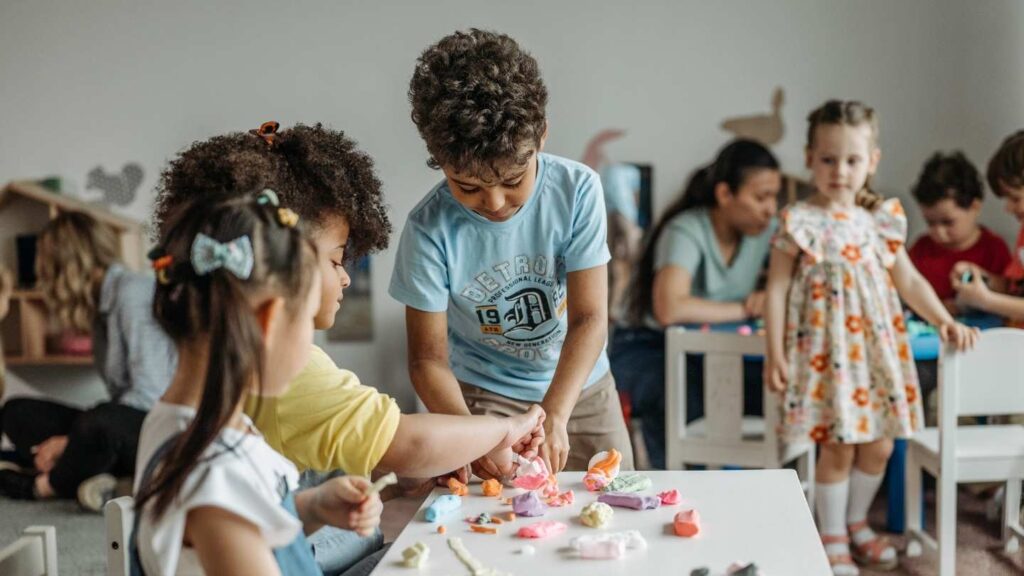
Touch (tactile). Finger painting, water tables, play dough, and sensory bins filled with dried rice or cotton balls let children explore textures, temperatures, and resistance. Tactile play strengthens small muscle groups in children and builds comfort with different materials. Infants grasp soft fabric; toddlers squeeze wet sponges; preschoolers handle clay and beads.
Sight (visual). High-contrast black-and-white patterns support visual tracking in babies. Picture books, matching games, and sorting various objects by color or different shapes help preschoolers build visual discrimination, a foundation for early literacy.
Hearing (auditory). Listening walks (birds, wind, traffic sounds), songs, rhymes, and musical instruments like drums and shakers help children distinguish pitch, rhythm, and speech sounds. Auditory processing develops from infancy and supports later reading and communication.
Smell (olfactory). Scented play dough, flowers, herbs from a garden, and scented markers connect with emotion and memory. Children learn descriptive words like “sweet,” “sour,” and “earthy” through direct olfactory experience.
Taste (gustatory). Safe food exploration during cooking projects or snack time contributes to sensory tolerance, discrimination, and language. Toddlers try soft banana and crunchy crackers; preschoolers compare salty and sweet during a simple recipe.
Vestibular (balance and movement). Swinging, spinning, climbing, and jumping support balance, spatial orientation, and coordination. Vestibular systems help children learn how to shift weight, control posture, and move with intention. These are practiced daily during outdoor play.
Proprioception (body awareness). Obstacle courses, crawling, pushing heavy carts, and animal walks (bear crawl, crab walk) help children judge how to move their body parts safely in space. Proprioception is what lets a child know how hard to push a door or how close to stand to a friend.
Sensory Activities and Cognitive Skills
Children develop problem-solving skills through sensory play activities because hands-on exploration creates direct feedback loops: pour too fast, and water spills; stack blocks too high, and they topple. Engaging in sensory play helps children learn cause and effect in a concrete, repeatable way.
Specific examples by age:
- Infants explore a crinkle book, learning that squeezing produces sound
- Toddlers fill and dump buckets, testing gravity, volume, and coordination
- Preschoolers mix cornstarch and water (“oobleck”) to observe how a substance behaves as both solid and liquid
Sensory play encourages exploration and experimentation in children, and children learn how things work through sensory play experiences. Pouring dried rice between measuring cups teaches volume and estimation. Sorting shells by size reinforces comparison. Building ramps for small toys lets children predict motion and test hypotheses.
Sensory activities enhance memory and observation skills. When a teacher at Children’s Learning Center narrates with questions (“What do you think will happen if we add more water?”), children practice prediction, reflection, and verbal reasoning. Sensory activities help children focus and block out distractions because the hands-on nature of the work anchors attention to the task.
For most children who learn best by doing rather than listening, sensory-rich problem solving is the entry point to early math, science, and logical thinking.
Building Fine and Gross Motor Skills Through Sensory Play
Sensory activities exercise both small muscles (fine motor skills) and large muscles (gross motor skills) that are critical for independence.
Fine motor development. Sensory play helps develop fine motor skills like writing. Scooping beans with a spoon, threading beads onto a string, squeezing sponges, and using child-safe tweezers to pick up small toys all build the hand strength and control needed for holding a pencil, buttoning a coat, and tying shoes. Activities like kneading dough improve hand muscles for writing. Engaging with sensory materials enhances coordination in children across all these tasks.
Gross motor development. Gross motor skills are developed through jumping and balancing activities. Crawling through tunnels strengthens the core. Dancing with scarves increases coordination and rhythm. Pushing heavy carts across a room builds leg and arm strength.
Age-appropriate examples at Children’s Learning Center:
| Program | Age Range | Motor-Building Sensory Activities |
| Caterpillars (Infant) | 6 weeks–12 months | Tummy-time mats, grasping soft toys, reaching for hanging objects |
| Ladybugs/Bumblebees (Toddler) | 12–24 months | Stacking building blocks, large crayons, push-pull toys |
| Dragonflies (Early Preschool) | 2–3 years | Pouring, climbing, scooping at sand tables |
| Butterflies (Pre-K) | 3–5 years | Pre-writing trays (salt, sand), cutting with safety scissors, painting |
Repeated sensory-motor experiences build coordination, strength, and confidence, helping children reach developmental milestones and fully participate in group activities and school tasks.
Language Development and Communication in Sensory-Rich Environments
Sensory activities give children natural reasons to listen, label, ask questions, and share ideas. Sensory play helps children develop language skills naturally because the experience itself generates something worth talking about.
Teachers model descriptive language during activities: “The foam feels squishy and soft,” “You picked the biggest, brightest leaf,” “Listen to how the drum sounds when you tap it gently.” Introducing new words during sensory play builds vocabulary, and children learn to describe their sensory experiences during play with increasing precision.
Infants develop receptive language skills through simple instructions and narration during routines. A caregiver saying “You feel the soft blanket” or “This spoon is cold” during feeding connects spoken language to a child’s senses in real time. Babies absorb these patterns months before they can communicate with words of their own.
Toddlers and older children learn expressive language by talking about textures, colors, sounds, and movements with classmates at sensory tables. Sensory activities encourage children to express their feelings verbally (“I don’t like the sticky part” or “This smells like flowers”). Children learn to communicate through sensory play activities as they negotiate, describe, and narrate alongside peers.
Families can mirror these strategies at home. Narrate bath time (“The water is warm; the soap is slippery”), talk about cooking smells, or describe the texture of groceries. These moments build language skills without any special equipment.
Social-Emotional Learning and the Calming Effect of Sensory Play
Sensory play helps regulate children’s overall arousal levels. Repetitive, rhythmic actions; raking sand, kneading dough, rocking in a chair, blowing bubbles; calm the nervous system and reduce stress. A quasi-experimental study of 4-to-5-year-olds in Indonesia who participated in eight sensory play sessions showed that the experimental group’s emotional regulation scores rose to 65.89, compared to 50.13 in the control group (p < .001).
Sensory play can calm children with hyperactivity or attention issues. Weighted sensory toys provide deep pressure for calming effects, and tools like fidget objects or textured cushions help children focus during group activities. Children learn to manage emotions through sensory processing skills over time, building self-regulation that carries into kindergarten and beyond.
Sensory play fosters social skills among children. Shared experiences at a water table or mud kitchen require cooperation, turn-taking, and empathy. Engaging in sensory play encourages problem-solving with peers. Sharing tools during sensory play promotes negotiation skills, and sensory play helps children adapt to others’ play styles as they work side by side.
A 12-week study comparing loose-parts play and relaxation interventions among preschoolers found that both groups showed increases in positive emotion expression and improved emotion discrimination. The control group, by contrast, showed increases in externalizing behavior.
At Children’s Learning Center, staff use sensory tools and quiet corners to help many children manage big feelings and rejoin group learning when ready. A teacher might quietly blow bubbles with an upset toddler or offer a weighted lap pad during story time as a form of co-regulation.
Body Awareness, Balance, and Safe Movement
Body awareness (proprioception) is a child’s ability to sense where their body parts are in space without looking. The vestibular sense handles balance and orientation through the inner ear. Together, these senses let children walk in a line, sit upright at circle time, and climb a playground structure without falling.
Children develop spatial awareness and body control through movement activities like animal walks (bear crawl, crab walk), balance beams, controlled spinning, and climbing. These activities help children gauge distance, effort, and position, the same skills that later support handwriting, sports, and classroom routines.
Improved body awareness connects to safety and self-confidence. A child who can sense how high they have climbed, how hard they are pushing, or how close they are standing to a friend is less likely to have accidental collisions or falls. Children’s Learning Center practices these skills daily in outdoor play spaces and indoor gym areas under close supervision.
Sensory Activities Across Early Childhood Stages
Children’s sensory needs and abilities shift from infancy through early school age. Here is what sensory development looks like at each stage.
Infants (6 weeks to 12 months). Babies explore the world through gentle sensory experiences: high-contrast black-and-white images for visual tracking, soft fabrics for tactile comfort, rattles and gentle music for auditory stimulation, and tummy time for building core strength and reach. These support secure attachment and early motor reflexes in infants.
Toddlers (12 to 24 months). Water play, finger painting, simple musical instruments like shakers and drums, pushing and pulling toys, and scribbling with large crayons all encourage children to explore through self-directed sensory input. Toddlers at this stage are building early language, movement confidence, and problem solving.
Early preschool (ages 2 to 3). Sand and water tables, science trays (floating vs. sinking), color-sorting games, sensory bins with dried beans or leaves, and dramatic play with props add complexity and choice. Children at this age begin to combine senses, using touch and vision together to sort natural materials or explore a mud kitchen.
Pre-K (ages 3 to 5). Multi-step activities emerge: cooking projects with measuring, simple experiments (vinegar and baking soda), pre-writing trays filled with salt or shaving cream, cutting, gluing, and dramatic play with themed props. These activities require planning, sequencing, and executive control, building the cognitive skills that prepare children for school.
Sensory-Rich Classrooms at Children’s Learning Center
Children’s Learning Center is a Missouri-accredited, play-based program in High Ridge that designs sensory-rich spaces for early learning across every classroom.
Each room includes developmentally appropriate sensory materials:
- Caterpillars (Infant): Soft toys, tummy-time mats, gentle music, high-contrast images
- Ladybugs and Bumblebees (Toddler): Water tables, block corners, large crayons, simple art supplies
- Dragonflies (Early Preschool): Sand tables, sensory bins, dramatic play props, science trays
- Butterflies (Pre-K): STEM trays, pre-writing sensory stations, real-life dramatic play props, cooking projects
Teachers align sensory activities with curriculum goals in early literacy, math, and social-emotional learning, treating them as integral parts of the day rather than filler time. Safety and cleanliness practices include supervised water play, age-appropriate materials (no small pieces for infants), sanitizing shared items, and monitoring for choking hazards.
Families near High Ridge, Missouri, can schedule a tour to see these sensory environments in person and talk with teachers about how sensory exploration supports each child’s unique developmental milestones.
Partnering with Families to Support Sensory Learning at Home
Family members are a child’s first teachers, and home routines are full of sensory learning opportunities. Parents do not need to buy elaborate kits or equipment.
Simple at-home ideas:
- Fill a shallow bin with dried rice or pasta, add measuring cups and spoons, and let toddlers pour and scoop
- Involve children in cooking: stirring, pouring, smelling spices, tasting safe ingredients
- Collect natural materials on neighborhood walks (pinecones, leaves, smooth stones) for sorting and comparing
- Set up a water play station with cups and funnels in the bathtub
Encourage children to explore at their own pace. Watch how your child responds to different sensory inputs. Some children love messy play; others prefer dry materials like sand or cotton balls. Adjusting activities to match a child’s comfort level builds trust and extends learning.
Children’s Learning Center communicates daily with families about classroom activities and offers suggestions to extend sensory exploration after pickup. Consistent sensory experiences at home and in child care reinforce routines, language, and self-regulation skills, helping families find a rhythm that supports their child at both locations.
Inclusive Sensory Activities for Diverse Needs
Many children experience sensory input differently. Some cover their ears in noisy rooms. Others avoid sticky textures or become unusually clingy when a classroom is too bright. These responses are not misbehavior; they are information about how a child’s sensory systems process the world.
Strategies that support families and children with diverse sensory profiles:
- Offer choices (brush painting vs. finger painting; dry sand vs. wet sand)
- Provide headphones or quiet corners for children who need reduced auditory input
- Start with brief exposures to new textures and gradually increase
- Use fidget objects or textured cushions to help children stay engaged during group time
Respectful observation and collaboration with other family members matter. When a child seems overwhelmed or withdrawn during sensory play, teachers at quality child care programs communicate with parents to identify patterns and adjust approaches. Experienced child care providers care about individual comfort and adapt group activities (dimming lights, lowering music volume) to keep all children engaged in learning.
Inclusive sensory planning benefits every child by offering a range of ways to explore, move, and express themselves.
Safe and Thoughtful Sensory Play: Practical Tips for Adults
With planning and supervision, sensory activities are both safe and beneficial for children at every age.
Key safety considerations:
- Choking hazards: Avoid small toys, beads, and dried beans with infants and young toddlers. Use larger items like cotton balls or fabric swatches instead.
- Food allergies: Check for allergies before gustatory play. Substitute non-food materials when needed.
- Non-toxic materials: Use washable, non-toxic paints, markers, and clays for all art activities.
- Water supervision: Never leave infants or toddlers unattended around water, even in shallow containers.
Set clear boundaries for messy play: smocks, floor mats, and designated areas help children feel free to explore while adults maintain a clean environment. Balance active movement activities with quieter, more focused sensory tasks throughout the day so children do not become overstimulated.
Licensed, accredited centers like Children’s Learning Center follow Missouri regulations and internal policies, including background checks for all staff, to keep sensory experiences safe and developmentally appropriate.
Sensory Activities in Choosing Quality Child Care
Families looking to find child care can use sensory-rich learning as one indicator of program quality. When visiting daycare centers or early learning programs, look for evidence that sensory exploration is woven throughout the day, not confined to a single bin in the corner.
Questions to ask on a tour:
- How does the center use sensory activities to support early learning and developmental milestones?
- How do teachers handle children who dislike certain textures or loud spaces?
- Are sensory experiences connected to curriculum goals like early literacy and social skills?
High-quality programs integrate sensory experiences across daily routines and connect them to cognitive development, language skills, and kindergarten readiness. Child care services that treat sensory play as an integral part of the curriculum rather than an afterthought are more likely to support the full range of a child’s development.
Parents should feel comfortable sharing their child’s unique sensory preferences and needs when enrolling. This builds a true family-provider partnership and helps providers care for each child with greater understanding.
Balancing Screen Time with Hands-On Sensory Learning
Digital devices are part of daily life, but young children still need abundant real-world sensory experiences. Current early childhood education guidance prioritizes active, hands-on exploration over passive screen viewing for children under 5.
A 2026 study on 2-to-3-year-olds with more than three hours of daily screen exposure found that participation in a neuroplasticity-based sensory-motor play program produced measurable positive changes in development. Replacing even small amounts of screen time with sensory play has practical benefits.
Families can try:
- Water play before dinner instead of a video
- A nature walk on weekends instead of a cartoon
- Allowing children to help with cooking, stirring, and measuring
Children’s Learning Center keeps screens minimal and intentional in early learning classrooms, focusing on real materials and face-to-face interaction. Rich sensory experiences help build attention, impulse control, and creativity, which support healthier technology use later in life.
How Children’s Learning Center Integrates Sensory Play into Its Programs
Each program at Children’s Learning Center uses sensory activities aligned with developmental needs, from infant care through school-age programming.
Infant care (Caterpillar Classroom). Soft toys, tummy-time mats, gentle music, and high-contrast visuals support secure attachment, early motor skills, and sensory development for babies as young as 6 weeks old.
Toddler care (Ladybugs and Bumblebees). Hands-on centers with water tables, block corners, and simple art projects encourage children to develop early language, movement, and problem solving. These classrooms are designed so toddlers can safely explore different objects and textures throughout the day.
Early preschool (Dragonflies) and Pre-K (Butterflies). More complex sensory centers include STEM trays, dramatic play with real-life props, and pre-writing sensory stations. The Butterflies classroom targets kindergarten readiness through sensory-rich, curriculum-guided activities in early literacy, math, and social skills.
Children’s Learning Center holds Missouri Accreditation, maintains secure building access with keypad entry and security cameras, and communicates closely with families about each child’s development. The center’s programs page at clc-mo.com/programs provides details on each classroom.
Conclusion: Sensory Experiences as the Foundation for Lifelong Learning
Sensory activities support every aspect of a child’s development: cognitive, physical, social, emotional, and language growth. From the first weeks of life through kindergarten entry, hands-on exploration is how children learn to think, move, communicate, and connect with others.
Early childhood is a unique window for building these foundations. Parents and caregivers do not need elaborate materials or expensive equipment. A bin of dried rice, a walk through the neighborhood, a few minutes of play dough at the kitchen table; these are the building blocks of sensory learning.
For families in and around High Ridge, Missouri, Children’s Learning Center offers a safe, nurturing, and sensory-rich environment for children 6 weeks to 12 years old. To see the classrooms in action and learn how sensory-focused, play-based learning supports your child’s growth, contact the center to schedule a tour.
Frequently Asked Questions
At what age should I start sensory activities with my child?
Sensory learning begins from birth. Newborns respond to gentle touch, familiar voices, and changes in light. Simple, safe sensory activities (soft fabrics, calm music, gentle rocking) can be offered from the first weeks of life. Activities should always match the child’s age: soft textures and gentle movement for infants, supervised water play and grasping objects for older babies, and more complex exploration for toddlers and preschoolers. Children’s Learning Center introduces sensory experiences as early as 6 weeks old in the Caterpillar Classroom, with close supervision and safety at all times.
How do I know if my child is overwhelmed by sensory input?
Common signs include covering ears, avoiding certain textures, crying or withdrawing in noisy rooms, and becoming unusually clingy or irritable during activities. If you notice these patterns, reduce stimulation by lowering noise, offering a quieter space, or simplifying materials. Watch for signs of relief. If concerns persist, discuss them with your pediatrician and your child’s care providers, who can observe patterns and suggest supportive strategies tailored to your child’s needs.
Can sensory play help my child get ready for kindergarten?
Yes. Sensory activities build fine motor skills for writing (using tweezers, squeezing dough), attention for group learning, early math and science concepts (sorting, measuring, experimenting), and social skills for working with classmates (sharing materials, cooperating at building stations). Children’s Learning Center’s Pre-K program in the Butterflies classroom uses sensory-rich, curriculum-guided activities designed to support kindergarten readiness across all of these areas.
Do I need special supplies at home to support my child’s sensory development?
Most effective sensory activities use simple household or natural materials: water, sand, rice, cardboard boxes, pots and pans, leaves, and pinecones from outside. Start with a shallow bin, a few measuring cups, and safe kitchen tools. Focus on time and attention rather than expensive products. Families find that adapting ideas from their child’s classroom newsletters or teacher suggestions is a practical way to mirror similar sensory experiences at home.
How does Children’s Learning Center keep sensory play safe and clean?
The center selects materials carefully by age group, avoids small pieces with infants and young toddlers, and closely supervises all water play. Shared items are cleaned and sanitized regularly, materials are rotated, and messy play is managed so children can explore freely in a hygienic environment. As a Missouri-accredited, state-licensed program, Children’s Learning Center follows established health and safety guidelines for all sensory activities, and all staff complete required background checks.